SAFe in 60 seconds
- What it is: the Scaled Agile Framework (SAFe) is "a knowledge base of proven, integrated principles, practices, and competencies for achieving business agility using Lean, Agile, and DevOps".[1]
- Who made it: Dean Leffingwell, creator of SAFe and co-founder of Scaled Agile, Inc.[1] SAFe 6.0 is the latest numbered version.[2]
- The heart of it: the Agile Release Train, a team of agile teams of generally 50 to 125 people that plans together every 8 to 12 weeks at PI Planning.[3][4]
- Foundations: four core values and ten Lean-Agile principles.[5][6]
- Four configurations: Essential, Large Solution, Portfolio and Full SAFe. Essential SAFe is the common starting point.[7]
- The debate: SAFe is the most used enterprise scaling framework,[8] and is often criticised as heavy and prescriptive.[9]
1. What is the Scaled Agile Framework (SAFe)?
The Scaled Agile Framework (SAFe) is a framework for applying Lean, Agile and DevOps practices across many teams, up to the portfolio. Teams are organised into Agile Release Trains that plan and deliver together on a shared cadence, linked to strategy and funding.
Kendis is a SAFe tool that sits on top of Jira and Azure DevOps, covering PI Planning, program and solution boards, dependencies, PI Objectives, OKRs and ROAM risks.
SAFe is built around five disciplines: Leadership and Culture, Team and Technical Agility, Product Development Flow, Large Solution Integration and Delivery, and Lean Portfolio Management.[1] Most people meet it through four practices:
- Agile Release Trains (ARTs). "A long-lived team of Agile teams that incrementally develops, delivers, and often operates one or more solutions in a development value stream."[10] See the Agile Release Train guide.
- Planning Intervals (PIs). "A timebox of 8-12 weeks, during which the Agile Teams on an ART deliver the work needed to meet their PI Objectives."[4]
- PI Planning. "Typically a 2-day event for the entire ART" where teams build a joint plan and commit to PI objectives.[11] See the PI Planning guide.
- Lean Portfolio Management. Funding and governing value streams instead of projects.[10] See the Lean Portfolio Management guide.
What is scaled agile, and is it the same as SAFe?
Not quite. "Scaled agile" in lower case is the general practice of running agile across many teams, with SAFe, LeSS, Nexus or a homegrown model; the scaling agile guide covers it. "Scaled Agile" with capitals usually means Scaled Agile, Inc., the company behind SAFe.
Who created SAFe, and what is the current version?
SAFe was created by Dean Leffingwell, who co-founded Scaled Agile, Inc.[1] SAFe 6.0, described at launch as "a comprehensive update from version 5.1",[12] is still the version the framework site presents as "the latest version of SAFe".[2] Scaled Agile now publishes changes monthly, and in June 2026 it "officially introduced AI-Native SAFe", which it calls a reinvented operating model.[13] The core concepts in this guide apply to both.
2. What are the SAFe core values?
The four SAFe core values are alignment, transparency, respect for people and relentless improvement. Scaled Agile calls them the foundational beliefs behind SAFe's effectiveness, and says that without them the practices will fail to deliver the intended results.
Scaled Agile expects people in authority to model the core values "in their words and actions".[5] What each one means in practice:
| Core value | What it means | What it looks like in practice |
|---|---|---|
| Alignment | Everyone understands the strategy and how their work contributes to it. | Every feature traces to a PI objective, and every PI objective to a strategic theme or OKR. |
| Transparency | Plans, progress and problems are visible to everyone who needs them. | One shared planning board, dependencies in the open, risks raised at PI Planning, not discovered at the end. |
| Respect for people | People doing the work are trusted to decide how to do it. | Teams estimate and commit to their own plan. Leaders remove impediments instead of assigning tasks. |
| Relentless improvement | Learning and improving never stops. | Every PI ends with Inspect and Adapt, and improvement items enter the backlog like any other work. |
3. What are the 10 SAFe principles?
SAFe is based on ten Lean-Agile principles: take an economic view; apply systems thinking; assume variability and preserve options; build incrementally with fast, integrated learning cycles; base milestones on objective evaluation of working systems; make value flow without interruptions; apply cadence and synchronize with cross-domain planning; unlock the intrinsic motivation of knowledge workers; decentralize decision-making; and organize around value.
Scaled Agile says "SAFe is based on ten immutable, underlying Lean-Agile principles" that "inspire and inform the roles and practices of SAFe".[6] When a practice does not fit, the principles are what guide the teams.
Principle 1 underpins WSJF prioritisation, principle 6 is what flow metrics measure, and principle 7 is why PI Planning exists.
4. What are the four SAFe configurations?
SAFe has four configurations: Essential SAFe for Agile Release Trains, Large Solution SAFe for solutions that need several ARTs and suppliers, Portfolio SAFe which adds Lean Portfolio Management, and Full SAFe which combines them all.[2] Choose the smallest one that solves your problem.
| Configuration | Official definition | Typical fit | Adds |
|---|---|---|---|
| Essential SAFe | "The minimal elements necessary for Agile Release Trains to deliver solutions and is the simplest starting point for implementation."[10] | One or a few ARTs, each delivering its own solution | ARTs, PI Planning, RTE, Product Management, System Architect, Business Owners |
| Large Solution SAFe | "For enterprises building large and complex solutions that do not require portfolio concerns."[10] | Systems that need several ARTs and suppliers, such as cyber-physical or regulated systems | Solution Train, Solution Management, Solution Architect, Solution Train Engineer, capabilities, suppliers |
| Portfolio SAFe | "Provides strategy and investment funding, Agile portfolio operations, and Lean governance for one or more value streams."[10] | Organisations that want to fund value streams instead of projects | Lean Portfolio Management, strategic themes, portfolio backlog, epics, Epic Owners |
| Full SAFe | "The most comprehensive version of the Framework and supports enterprises that build and maintain a portfolio of large and complex solutions."[10] | Large enterprises with several large solutions under one portfolio | Everything above |
Essential SAFe: where most organisations start
Essential SAFe is "a common SAFe starting point" and "excludes Enterprise Solution Delivery and Portfolio concerns". The Agile Release Train "is the heart of Essential SAFe".[7]
Large Solution SAFe and the Solution Train
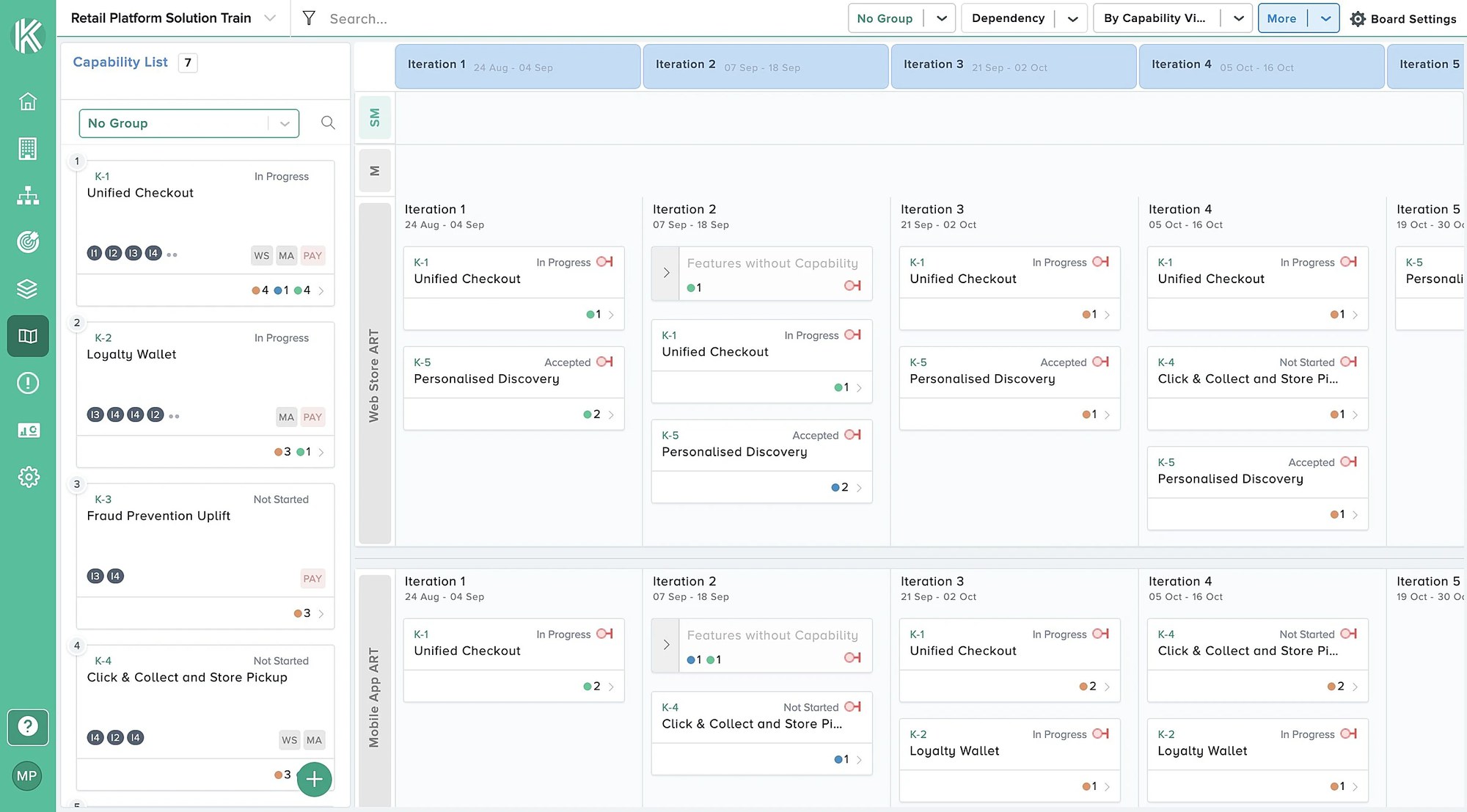
Large Solution SAFe includes Essential SAFe and adds the roles, events and artifacts to coordinate "multiple ARTs and suppliers" in a Solution Train.[14] In Kendis, the solution board shows every ART of a Solution Train on one board.
Portfolio SAFe and Full SAFe
The portfolio configuration "includes Essential SAFe" and adds Lean Portfolio Management and portfolio-level roles, events and artifacts (SAFe 5.1 wording, archived).[15] Full SAFe combines the portfolio and large solution levels.[10] It is the configuration most people picture when they call SAFe heavy.
5. Key SAFe roles
An Agile Release Train is led by the Release Train Engineer, Product Management, the System Architect and Business Owners, with a Product Owner and Scrum Master/Team Coach in each team. Large solutions add Solution Train roles; portfolios add Lean Portfolio Management, Epic Owners and Enterprise Architects.
| Role | Level | Responsibility |
|---|---|---|
| Release Train Engineer (RTE) | ART | "A servant leader and ART coach who facilitates ART events and processes, and supports teams in delivering value."[16] |
| Product Management | ART | Responsible for "defining desirable, viable, feasible, and sustainable solutions that meet customer needs."[10] Owns the ART backlog of features. |
| System Architect | ART | "Defining and communicating a shared technical and architectural vision for the solutions developed by an ART."[10] |
| Business Owners | ART | "Key ART stakeholders who have the primary business and technical responsibility for return on investment (ROI), governance, and compliance."[10] |
| Product Owner | Team | "Primarily responsible for maximizing the value delivered by the team."[10] |
| Scrum Master/Team Coach | Team | "A servant leader and coach for an Agile team who facilitates team events and processes."[10] |
| Solution Train Engineer (STE) | Large solution | Facilitates Solution Train events and "coordinates the work of ARTs and Suppliers".[10] |
| Solution Management and Solution Architect | Large solution | Solution-level equivalents of Product Management and the System Architect.[14] |
| Lean Portfolio Management | Portfolio | Strategy and investment funding, Agile portfolio operations and governance.[10] See the LPM guide. |
| Epic Owner and Enterprise Architect | Portfolio | The Epic Owner coordinates "epics through the portfolio Kanban system"; the Enterprise Architect sets "the portfolio's technology vision, strategy, and roadmap".[10] |
Agile teams themselves are "a cross-functional group of typically ten or fewer individuals".[10]
6. SAFe events: PI Planning, system demo, Inspect and Adapt and more
Each PI starts with PI Planning, is coordinated through the ART Sync, shows integrated progress at a System Demo after every iteration, and ends with Inspect and Adapt. Teams run their own iteration events inside that rhythm.
| Event | When | Purpose |
|---|---|---|
| PI Planning | Start of every PI | "A cadence-based event for the entire ART that aligns teams and stakeholders to a shared mission and vision."[10] |
| ART Sync | Regularly during the PI | Combines the PO Sync and Coach Sync; "the primary mechanism for the ART to align during the PI".[17] |
| PO Sync | Part of the ART Sync | Visibility into progress "toward meeting its PI objectives" and any adjustments needed.[10] |
| Coach Sync | Part of the ART Sync | Helps "coordinate ART dependencies and provides visibility into progress and impediments".[10] |
| System Demo | After every iteration | "An integrated view of new features for the most recent iteration delivered by all the teams on the ART."[18] |
| Inspect and Adapt | End of every PI | A PI System Demo, "a quantitative and qualitative measurement review, and a retrospective and problem-solving workshop".[19] |
| Iteration events | Every iteration | Iteration planning, team sync, iteration review and retrospective, run by each team.[10] |
| Pre-Plan and Solution Demo | Every PI, large solutions | Pre-Plan "describes the activities that align and prepare ARTs within a Solution Train for PI planning"; the Solution Demo shows the integrated work of all ARTs and suppliers.[10] |
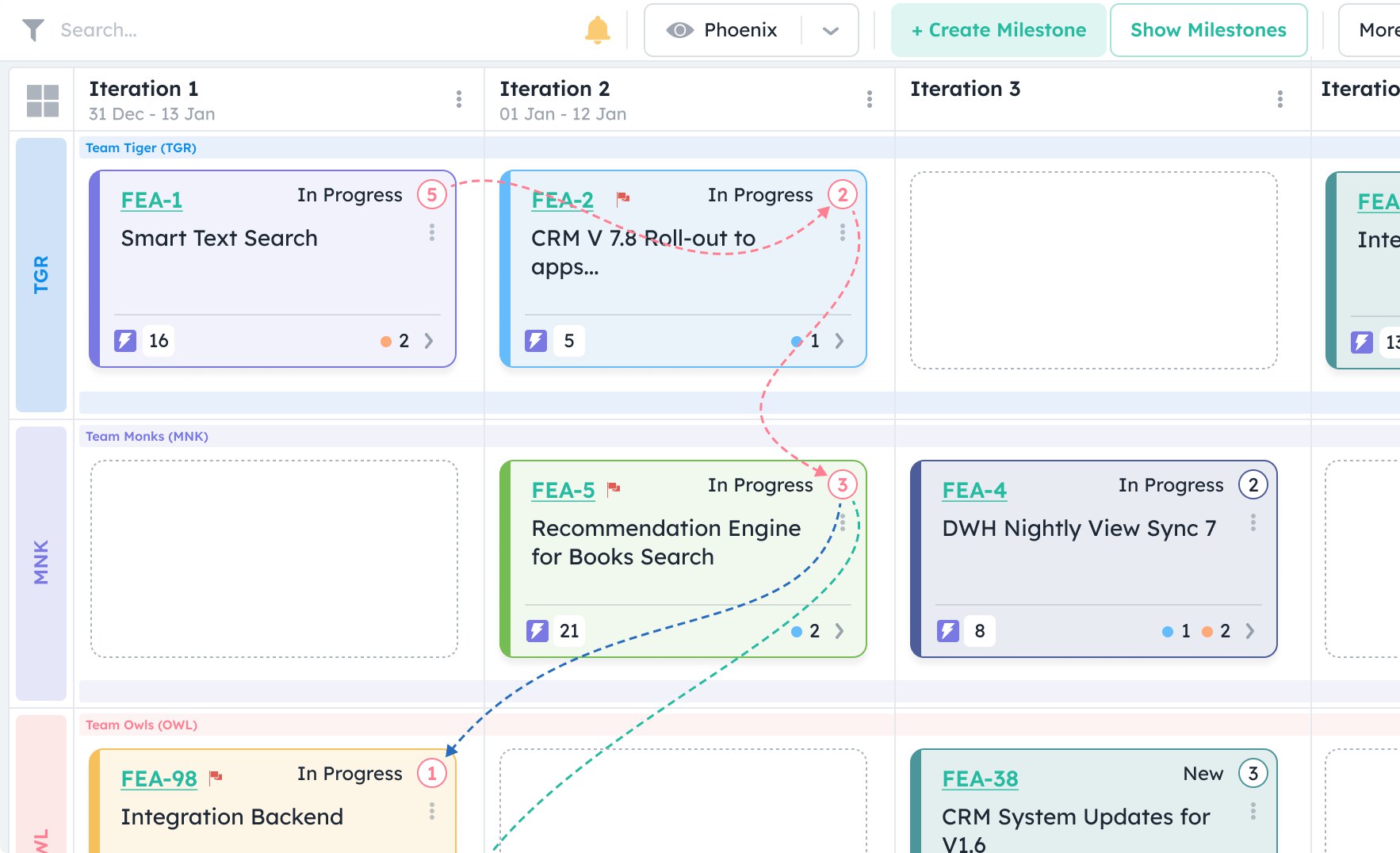
PI Planning is "led by the Release Train Engineer (RTE)".[11] It produces PI objectives and a program board of features and dependencies, and risks are sorted with ROAM: resolved, owned, accepted or mitigated.
7. SAFe artifacts: epics, capabilities, features and stories
SAFe breaks work down from epics at the portfolio level, to capabilities for large solutions, to features for an Agile Release Train, to stories for a team. PI objectives summarise what each team and train intends to achieve in a PI, and roadmaps show the plan over time.
- Epic: "a significant solution development initiative", managed in the portfolio backlog.[10]
- Capability: "large solution functionality whose implementation often spans multiple ARTs and is sized to be delivered within a PI".[10]
- Feature: "solution functionality that delivers business value, fulfills a stakeholder need, and is sized to be delivered by an Agile Release Train within a PI".[10]
- Story: "short descriptions of a small piece of desired functionality written from the user's perspective".[10]
- PI objectives: "the business and technical goals that teams and trains intend to achieve in the upcoming PI", either committed or uncommitted.[10]
- Strategic themes: "portfolio-level business objectives that provide competitive differentiation and strategic advantage".[10]
- Roadmaps: portfolio, solution and PI roadmaps that show planned deliverables over time. See the agile roadmap guide.
Many organisations also link PI objectives to OKRs, so trains report progress against outcomes.
8. SAFe vs Agile vs Scrum: what is the difference?
Agile is a set of values and principles. Scrum is a framework for one team of ten or fewer people. SAFe applies Agile, Lean and DevOps across many teams and the portfolio, with Scrum or Kanban inside each team. They are layers, not alternatives.
Scaled agile vs agile is really about scope. The Agile Manifesto's first principle is "our highest priority is to satisfy the customer through early and continuous delivery of valuable software".[20] It says nothing about how thirty teams coordinate. Scrum gives one team, "typically 10 or fewer people",[21] a method. SAFe adds what sits above: trains, PIs, portfolio funding and governance. "Sprint is a Scrum method term for what SAFe defines as an iteration."[10]
| Agile | Scrum | SAFe | |
|---|---|---|---|
| What it is | Values and principles (the Agile Manifesto) | A framework for one team | A framework for many teams and the portfolio |
| Scope | Any team or organisation | One team of 10 or fewer | Teams, ARTs of 50 to 125 people, Solution Trains, portfolios |
| Planning horizon | Not defined | One sprint, up to one month | One PI of 8 to 12 weeks, plus roadmaps |
| Roles | Not defined | Product Owner, Scrum Master, Developers | Team roles plus RTE, Product Management, System Architect, Business Owners and more |
| Prioritisation | Not defined | Product Owner orders the Product Backlog | WSJF at feature and epic level |
| Funding and governance | Not covered | Not covered | Lean Portfolio Management, lean budgets, guardrails |
| Prescription | Low | Low to medium | High |
SAFe vs Scrum
SAFe does not replace Scrum. Teams on an ART use SAFe Scrum, which works with "iterations, Kanban systems, and Scrum events", or SAFe Team Kanban, a flow-based method that operates "within the ART iteration cadence".[10] The difference is everything around the team: a shared PI cadence, joint planning, a System Demo of integrated work and portfolio-level funding. In Scrum, one Product Owner is "accountable for maximizing the value of the product";[21] in SAFe, that is split between Product Management for the train and Product Owners for the teams.[10]
9. SAFe vs other scaling frameworks, in brief
SAFe is the most prescriptive scaling framework, covering portfolio, funding and governance as well as teams. LeSS, Scrum@Scale and Nexus are lighter and stay closer to Scrum. A large survey found little difference in team effectiveness between approaches, so fit with culture matters more than the framework chosen.
- LeSS scales one-team Scrum: "up to eight teams (of eight people each)", with LeSS Huge for larger products.[22]
- Scrum@Scale links teams through a Scrum of Scrums, where "the optimal number of teams in a Scrum of Scrums is 4 or 5".[23]
- Nexus is "a group of approximately three to nine Scrum Teams that work together to deliver a single product".[24]
In a 2023 study of 15,078 agile team members and 1,841 stakeholders, Verwijs and Russo found "minor differences in effectiveness across scaling strategies" and advised that organisations "select based on their culture and management style".[25] For the full side-by-side comparison, read the scaling agile guide, and for how Kendis supports each model, see agile scaling models.
10. The SAFe Implementation Roadmap, step by step
The SAFe Implementation Roadmap is Scaled Agile's recommended sequence for adopting SAFe: build the case and the change team, train leaders, organise around value, launch and coach the first ART, then launch more trains, enhance the portfolio and accelerate.
Scaled Agile defines the roadmap as "an overview graphic and a 14-article series that describes a strategy and an ordered set of activities for successfully implementing SAFe", based partly on John Kotter's change management work.[26] It also admits "there is rarely a perfectly sequential step-by-step implementation".[26] The steps, with Kendis summaries:
- Reach the tipping point. Agree on a business problem the current way of working cannot solve.
- Train Lean-Agile change agents. Train a group of internal change agents who will lead, teach and coach the change.
- Create a Lean-Agile Center of Excellence. Form the LACE, a small agile team dedicated to implementing the new way of working.
- Train executives, managers and leaders. Leaders learn the system so they can lead the change, not just sponsor it.
- Lead in the digital age. Help leaders adopt the mindset and behaviours the new way of working needs.
- Organize around value. Identify value streams, then design the ARTs that serve them.
- Create the implementation plan. Choose the first value stream and ART, and plan the launch sequence for the rest.
- Prepare for ART launch. Name the roles, prepare the ART backlog and set the first PI Planning date.
- Train teams and launch the ART. Train the teams together and run the first PI Planning event.
- Coach ART execution. Coach the train through its first PIs: syncs, system demos and Inspect and Adapt.
- Launch more ARTs and value streams. Repeat for the next trains, adding Solution Trains where needed.
- Enhance the portfolio. Extend Lean Portfolio Management, so strategy, funding and governance connect to the trains.
- Accelerate. Measure, share what works and keep improving, so the change sustains itself.
In our experience the steps that slip most are training leaders and organising around value. A train that mirrors the old org chart inherits all of its dependencies.
11. Benefits and criticisms of SAFe
SAFe gives large organisations a shared language, a planning cadence and a link from strategy to delivery. Critics say it is heavy and prescriptive. Independent research suggests culture and management style matter more than the framework chosen.
Benefits
- Adoption and a shared language. SAFe was the most used enterprise framework in the 17th State of Agile Report, at 26% of respondents, though 22% followed no mandated framework at all.[8] Scaled Agile reports over 2,000,000 people trained.[1]
- Reported outcomes. Scaled Agile lists typical benefits of a 20 to 50% increase in productivity, 25 to 75% improvements in quality and 30 to 75% faster time-to-market.[1] These are the vendor's figures from its customer stories, not independent research.
- Engagement. In Scaled Agile's own 2025 survey of 1,200 professionals, 68% reported "a significant or some increase in employee satisfaction".[27]
- Answers above the team. Even SAFe critic Ron Jeffries wrote that "Scrum and Agile really don't offer much help at these levels" and that SAFe's guidance on portfolio, program and team "is better than no guidance at all".[28]
Criticisms
- Too prescriptive. Scrum co-creator Ken Schwaber criticised SAFe in 2013 as "a simple, one-size fits all approach", arguing that "values and principles scale, but practices are context sensitive".[9]
- Not agile at heart. Ron Jeffries, after taking the SPC course, wrote that "organizations trying it will see improvement" but that "SAFe isn't really Agile in its heart".[28]
- Hard to adopt. A study of a large bank two years into SAFe found challenges in "management and organization, education and training, culture and mindset", requirements, quality assurance and architecture.[29] Conboy and Carroll identified nine recurring challenges across 13 transformations using SAFe and other frameworks.[30]
A fair reading: SAFe works best as principles plus a tested default structure, adopted at the smallest configuration that solves a real problem, and worst as an org chart installed from a poster. Scaled Agile itself says "not every SAFe recommended practice will apply equally in every circumstance".[6]
12. SAFe certification
SAFe certifications are issued by Scaled Agile, Inc., usually after a course and an exam. They are grouped into foundational, advanced and expert levels, and include SAFe Agilist (Leading SAFe), SAFe Scrum Master, SAFe Product Owner/Product Manager, Release Train Engineer and SAFe Practice Consultant (SPC).
Scaled Agile's certification page lists 8 foundational, 5 advanced and 3 expert certifications, and describes a three-step path: explore certifications, prepare for the exam ("study on your own or join an optional, instructor-led course"), then take the exam.[31] Courses in its catalogue include Leading SAFe (SA), SAFe for Teams (SP), SAFe Scrum Master (SSM), SAFe Product Owner/Product Manager (POPM), SAFe Release Train Engineer (RTE), SAFe Lean Portfolio Management (LPM) and Implementing SAFe (SPC).[31] Kendis does not offer or endorse any certification.
13. SAFe tools: Jira Align, Jira, Azure DevOps and Kendis
Most SAFe organisations keep team work in Jira or Azure DevOps and add a planning layer for trains and the portfolio: Jira Align, the Program board in Jira Premium plans, or Kendis on top of Jira and Azure DevOps.
| Tool | What it covers | Notes |
|---|---|---|
| Jira Align (Atlassian Align) | Portfolio, program and team planning across value streams | Atlassian positions it to "plan and deliver across portfolios, programs, and value streams" and lists SAFe among supported frameworks.[32] |
| Jira Plans Program board | PI-style planning across several teams | Available with Jira Cloud Premium and Enterprise. Atlassian says it "isn't designed for real-time collaborative planning sessions such as Big Room Planning".[33] |
| Azure Boards | Teams, backlogs and boards configured for SAFe | Microsoft documents how Azure Boards "supports SAFe practices through teams, backlogs, boards, reports, and metrics".[34] |
| Kendis | PI Planning, program and solution boards, dependencies, PI objectives, ROAM risks, OKRs | A planning layer on top of Jira and Azure DevOps with two-way sync; works for SAFe and other scaling models. |
In Kendis, the program board holds each ART's features, dependencies and PI objectives, and a tracking state keeps a snapshot of the plan to compare with what happened. The solution board links up to 30 PI boards, from Jira and Azure DevOps, with each ART in its own swimlane. OKRs and strategic themes connect portfolio goals to PI objectives. See Kendis compared for other SAFe tools.
14. Common SAFe mistakes
The most common SAFe mistakes are starting with Full SAFe, renaming departments as trains, training teams but not leaders, running PI Planning top down, and measuring output instead of outcomes.
- Starting with Full SAFe. Begin with Essential SAFe and one train. Add levels only when a real problem needs them.
- Trains that mirror the org chart. An ART built from existing departments keeps every hand-off. Organise around value streams first.
- Training teams but not leaders. If leaders do not understand the system, they will manage it like the old one.
- PI Planning as a top-down briefing. Teams must build and commit to their own plans, or the commitment means nothing.
- Ignoring dependencies until execution. Make them visible on the board during planning, and review them at every ART Sync.
- Measuring velocity instead of outcomes. Track business value delivered against PI objectives, predictability and flow.
- Prioritising by opinion. Use WSJF or another explicit economic model.
Put this into practice, free for 6 months
Kendis is a PI Planning and tracking platform that sits on top of Jira and Azure DevOps. The free trial runs for six months, long enough to plan and track two full PIs with your real backlog before anyone has to approve a budget.
- 6 months free, no credit card
- Choose EU hosting (OVHcloud, Frankfurt) or US hosting (AWS)
- Planning board, dependencies, PI objectives, ROAM risks, solution boards
- Two-way sync with Jira Cloud, Jira Data Center and Azure DevOps
- ISO/IEC 27001 certified, GDPR compliant, DORA Schedule available
- No user caps and no setup costs during the trial
One trial per organisation that has not used Kendis in the last twelve months. After the trial, Premium Cloud is $14 per user per month billed annually, or $16 monthly, and you license only the people who plan. SSO, Kendis AI and premium support are part of paid plans. See pricing and the free trial terms.
SAFe: frequently asked questions
What is SAFe?
SAFe, the Scaled Agile Framework, applies Lean, Agile and DevOps practices across many teams and up to the portfolio. Teams form Agile Release Trains that plan together every 8 to 12 weeks at PI Planning.
What is the difference between SAFe and Agile?
Agile is a set of values and principles. SAFe is a framework that applies them, with Lean and DevOps practices, across many teams, trains and portfolios.
What is the difference between SAFe and Scrum?
Scrum is a framework for one team of typically ten or fewer people. SAFe coordinates many teams in Agile Release Trains with a shared PI cadence and portfolio governance. Teams inside SAFe often use Scrum.
What are the SAFe core values?
Alignment, transparency, respect for people and relentless improvement.
What are the 10 SAFe principles?
Take an economic view; apply systems thinking; assume variability and preserve options; build incrementally with fast, integrated learning cycles; base milestones on objective evaluation of working systems; make value flow without interruptions; apply cadence and synchronize with cross-domain planning; unlock the intrinsic motivation of knowledge workers; decentralize decision-making; organize around value.
What are the four SAFe configurations?
Essential SAFe, Large Solution SAFe, Portfolio SAFe and Full SAFe. Essential is the minimal starting point; Full SAFe is the most comprehensive.
Is SAFe still used in 2026?
Yes. SAFe 6.0 is still the latest numbered version, Scaled Agile updates it monthly and introduced AI-Native SAFe in June 2026, and SAFe was the most used enterprise framework in the 17th State of Agile Report.
What is the SAFe Implementation Roadmap?
Scaled Agile's recommended sequence for adopting SAFe, from reaching the tipping point and training leaders to launching Agile Release Trains, enhancing the portfolio and accelerating.
Who issues SAFe certifications?
Scaled Agile, Inc., normally after a course and an exam. Examples include SAFe Agilist, SAFe Scrum Master, SAFe Product Owner/Product Manager and Release Train Engineer.
What tools support SAFe?
Most organisations run SAFe on Jira or Azure DevOps and add a planning layer such as Jira Align or Kendis, which adds program and solution boards, dependencies, PI objectives, ROAM risks and OKRs with two-way sync.
Sources
Every external claim in this guide links to the primary source below. All links were checked on 15 October 2026.
- Scaled Agile, Inc. About SAFe.
- Scaled Agile, Inc. SAFe 6.0 Configurations.
- Scaled Agile, Inc. Agile Release Train.
- Scaled Agile, Inc. Planning Interval (PI).
- Scaled Agile, Inc. Core Values.
- Scaled Agile, Inc. SAFe Lean-Agile Principles (last updated 4 May 2023).
- Scaled Agile, Inc. Essential SAFe.
- Digital.ai. 17th State of Agile Report (published January 2024).
- Ken Schwaber. unSAFe at any speed (6 August 2013).
- Scaled Agile, Inc. SAFe Glossary.
- Scaled Agile, Inc. PI Planning.
- Scaled Agile, Inc. What's New in SAFe 6.0 (archived version, last updated 2 January 2023, snapshot of 2 April 2023).
- Scaled Agile, Inc. What's new in SAFe?.
- Scaled Agile, Inc. Large Solution SAFe (last updated 5 December 2022).
- Scaled Agile, Inc. Portfolio SAFe (archived SAFe 5.1 version, last updated 10 February 2021, snapshot of 13 February 2023).
- Scaled Agile, Inc. Release Train Engineer.
- Scaled Agile, Inc. ART Sync.
- Scaled Agile, Inc. System Demo.
- Scaled Agile, Inc. Inspect and Adapt.
- Agile Alliance signatories. Principles behind the Agile Manifesto (2001).
- Ken Schwaber and Jeff Sutherland. The Scrum Guide (November 2020).
- The LeSS Company. What is LeSS? LeSS Framework.
- Scrum Inc. The Scrum@Scale Guide, version 2.1 (February 2022).
- Scrum.org. The Nexus Guide (January 2021).
- Christiaan Verwijs and Daniel Russo. Do Agile Scaling Approaches Make A Difference? An Empirical Comparison of Team Effectiveness Across Popular Scaling Approaches (arXiv, October 2023).
- Scaled Agile, Inc. SAFe Implementation Roadmap.
- Scaled Agile, Inc. State of SAFe Report 2025.
- Ron Jeffries. SAFe: Good But Not Good Enough (27 February 2014).
- Nilsson Tengstrand, Tomaszewski, Borg and Jabangwe. Challenges of Adopting SAFe in the Banking Industry: A Study Two Years after its Introduction (XP 2021; arXiv preprint).
- Kieran Conboy and Noel Carroll. Implementing Large-Scale Agile Frameworks: Challenges and Recommendations (IEEE Software, 2019; arXiv preprint).
- Scaled Agile, Inc. SAFe Certification Courses.
- Atlassian. Atlassian Align: Enterprise Portfolio Execution.
- Atlassian Support. What is the Program board in my plan?.
- Microsoft Learn. Implement SAFe with Azure Boards.
How this guide is maintained: definitions are checked against the framework pages and other primary sources listed above, and the guide is updated when terminology or guidance changes. Examples, checklists and practical advice are Kendis guidance and are not official SAFe material. SAFe and Scaled Agile Framework are registered trademarks of Scaled Agile, Inc.