Lean Portfolio Management in 60 seconds
- Definition: LPM "aligns strategy and execution by applying Lean and systems thinking approaches to strategy and investment funding, Agile portfolio operations, and governance."[1]
- Funding: budgets go to value streams, not projects.[2]
- Work: large initiatives are epics, managed through a portfolio Kanban.[1]
- Rhythm: a monthly portfolio sync and a quarterly strategic portfolio review.[2]
- Naming: Participatory Budgeting is now Strategic Investment Planning, and the Agile PMO is the Value Management Office.[3]
What is Lean Portfolio Management?
Lean Portfolio Management (LPM) is the SAFe approach to running a portfolio of products and solutions. It decides what the organisation invests in, funds long-lived value streams to do it, keeps the amount of large work in progress under control and governs through short, regular reviews in place of annual plans and stage gates.
A portfolio, in this sense, is "a set of value streams that delivers a continuous flow of valuable solutions to customers within a common funding and governance model."[1] A value stream is "the sequence of activities that contains all the people, systems, information, and materials needed to deliver value to a customer."[1]
The difference from traditional portfolio management is where the money and the decisions sit. Traditional PPM approves projects, staffs them temporarily and tracks them against a plan. LPM funds stable teams, lets them choose how to meet agreed outcomes, and keeps portfolio-level attention for the few initiatives large enough to need it.
What are the three dimensions of LPM?
SAFe describes three: strategy and investment funding, agile portfolio operations, and lean governance.[1]
Lean governance is "the dimension of Lean Portfolio Management that supports oversight of spending, audit, compliance, expenditure, measurement, and reporting"[1], with key activities that "include forecasting and budgeting dynamically, measuring portfolio performance, and coordinating continuous compliance."[4]
What are strategic themes?
Strategic themes are "portfolio-level business objectives that provide competitive differentiation and strategic advantage."[1] They are the link between enterprise strategy and what the portfolio funds, and SAFe recommends writing them as OKRs.[5]
A good set is short, three to five, and specific enough to say no with. "Grow in the Nordic market" is a wish. "Win 20 enterprise customers in the Nordics by year end, measured by signed contracts and active users" can be used to choose between two epics.
Themes shape the portfolio vision, which "describes the future state of a portfolio's value streams and solutions."[1] They also influence how budget is split between value streams and which epics are approved.
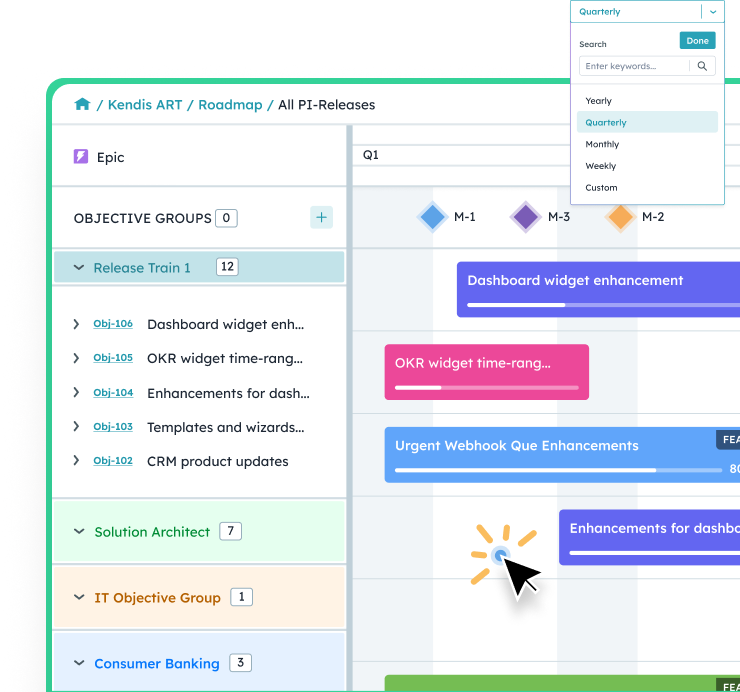
In Kendis, strategic themes and OKRs link to PI Objectives and features, so progress on a theme is calculated from delivery data.
What are lean budgets and guardrails?
Lean budgets are "a financial governance approach that funds value streams instead of projects."[1] Guardrails are the policies that keep that spending aligned with strategy without approving every item.
In practice, "the available portfolio budget is directly allocated to these value streams rather than the traditional approach of project-based funding."[2] The people closest to the work decide how to use it, inside four guardrails[6]:
| Guardrail | What it means |
|---|---|
| Guiding investments by horizon | Balance spending between today's products, emerging ones and future bets. |
| Applying capacity allocation | Reserve a share of capacity for enablers, maintenance and technical debt. |
| Approving significant initiatives | Epics above an agreed size need portfolio approval. |
| Continuous Business Owner engagement | Business Owners check that funded work stays aligned with priorities. |
Budgets are set in Strategic Investment Planning, "a collaborative process for allocating the portfolio budget to its value streams."[1] This was called Participatory Budgeting until 2026.[3]
What are epics and the portfolio Kanban?
An epic is "a significant solution development initiative."[1] The portfolio Kanban is "a method to visualize and manage the flow of portfolio epics, from ideation through analysis and implementation."[1] Together they stop the portfolio starting more big things than it can finish.
- Two types: "Business epics deliver value directly to the customer. Enabler epics enhance the architectural runway."[7]
- What each needs: "an MVP, a Lean business case, and an estimate of costs."[7]
- Who decides: epics "must be approved by Portfolio Leadership."[7]
- Who shepherds it: the Epic Owner is "responsible for coordinating epics through the portfolio Kanban system."[1] Enterprise Architects typically own enabler epics.[8]
- The business case: a lean business case is "a structured format for describing epics, their MVPs, and projected business value."[1]
The discipline that matters most is the work-in-progress limit. A portfolio with forty approved epics has no priorities.
What are the LPM events and roles?
Two events set the rhythm. The portfolio sync is generally monthly and reviews epics, KPIs, dependencies and impediments. The strategic portfolio review is typically quarterly, at least a month before the next PI Planning, and realigns strategy, implementation and budget.[2]
| Event or role | What it does |
|---|---|
| Portfolio sync | "Generally held monthly." Topics "include reviewing epic implementation, the status of KPIs, addressing dependencies, and removing impediments."[2] |
| Strategic portfolio review | "Typically held on a quarterly cadence, at least one month before the next PI Planning event." It "provides ongoing strategy, implementation, and budget alignment."[2] |
| Strategic Investment Planning | Allocates the portfolio budget to value streams.[1] |
| Portfolio leadership | "The team with the highest level of decision-making and financial accountability" for the portfolio.[1] |
| Value Management Office (VMO) | "Accountable for the portfolio's governance and day-to-day operations."[2] VMOs "often emerge from the existing PMO."[9] |
| Epic Owners | Take epics through the portfolio Kanban.[1] |
The timing of the strategic portfolio review is deliberate. Holding it a month before PI Planning means its decisions arrive as inputs to the quarterly plan and not as changes after it.
How do you move from project funding to product funding?
Fund durable teams around a product or value stream, give them outcomes to achieve, and review results regularly. Stop funding temporary teams against a fixed scope and a business case written before anyone has learned anything.
Sriram Narayan describes the contrast: projects "organize work into temporary, build-only teams and are funded with specific benefits projected in a business case", while product mode "uses durable, ideate-build-run teams working on a persistent business issue."[10] Mik Kersten's Project to Product makes the same case and introduces the Flow Framework for measuring it.[11] SAFe's guidance on the Value Management Office refers to "the move from temporal projects to long-lived products."[9]
| Project funding | Product or value stream funding | |
|---|---|---|
| What is funded | A scope of work | A team and its capacity |
| Team | Temporary, disbanded at the end | Long-lived |
| Approval | A detailed business case up front | A budget per value stream, with guardrails |
| Success measure | On time, on budget, to scope | Outcomes and value delivered |
| Change | A change request | A backlog decision |
| Review | Stage gates | Regular portfolio reviews |
How do you start with Lean Portfolio Management?
Start with visibility, not reorganisation. List every large initiative in one portfolio Kanban, agree a few strategic themes, set a monthly review, and limit how many epics are in progress. Change the funding model once people trust the new view.
- Define the portfolio. Which value streams and solutions are in it, and who leads it.
- Write three to five strategic themes as OKRs.
- Put every large initiative on one board. This step alone usually shows there are too many.
- Set a work-in-progress limit for epics in implementation, and hold to it.
- Start the monthly portfolio sync. Review epics, KPIs, dependencies and impediments.
- Ask for a lean business case and an MVP for each new epic.
- Add the quarterly strategic portfolio review a month before PI Planning.
- Move one value stream to a lean budget with guardrails, learn from it, then extend.
Kendis supports this from the delivery side. Roadmaps, strategic themes and OKRs and multi-level backlogs in ORG Views connect portfolio items to the features and stories that deliver them. Kendis does not do budgeting or financial tracking, so pair it with your finance tooling for that part.
Put this into practice, free for 6 months
Kendis is a PI Planning and tracking platform that sits on top of Jira and Azure DevOps. The free trial runs for six months, long enough to plan and track two full PIs with your real backlog before anyone has to approve a budget.
- 6 months free, no credit card
- Choose EU hosting (OVHcloud, Frankfurt) or US hosting (AWS)
- Planning board, dependencies, PI objectives, ROAM risks, solution boards
- Two-way sync with Jira Cloud, Jira Data Center and Azure DevOps
- ISO/IEC 27001 certified, GDPR compliant, DORA Schedule available
- No user caps and no setup costs during the trial
One trial per organisation that has not used Kendis in the last twelve months. After the trial, Premium Cloud is $14 per user per month billed annually, or $16 monthly, and you license only the people who plan. SSO, Kendis AI and premium support are part of paid plans. See pricing and the free trial terms.
Lean Portfolio Management: frequently asked questions
What is Lean Portfolio Management?
Lean Portfolio Management (LPM) aligns strategy and execution by applying Lean and systems thinking to strategy and investment funding, agile portfolio operations and governance.
What are the three dimensions of LPM?
Strategy and investment funding, agile portfolio operations, and lean governance.
What is a lean budget?
A lean budget is a financial governance approach that funds value streams instead of projects. Spending is kept in line with strategy by a small set of guardrails.
What are the lean budget guardrails?
SAFe lists four: guiding investments by horizon, applying capacity allocation, approving significant initiatives, and continuous Business Owner engagement.
What is an epic in SAFe?
An epic is a significant solution development initiative. Each one needs an MVP, a lean business case and a cost estimate, and must be approved by portfolio leadership.
What is the portfolio Kanban?
The portfolio Kanban is a method to visualise and manage the flow of portfolio epics from ideation through analysis and implementation.
How often does LPM review the portfolio?
The portfolio sync is generally held monthly. The strategic portfolio review is typically quarterly, at least one month before the next PI Planning event.
What happened to Participatory Budgeting in SAFe?
It is now called Strategic Investment Planning. Scaled Agile describes it as a collaborative process for allocating the portfolio budget to value streams.
Sources
Every external claim in this guide links to the primary source below. All links were checked on 12 October 2026.
- Scaled Agile, Inc.. SAFe Glossary.
- Scaled Agile, Inc.. Lean Portfolio Management Discipline (last updated 31 March 2025).
- Scaled Agile, Inc.. Strategic Investment Planning, formerly Participatory Budgeting (updated 1 May 2026).
- Scaled Agile, Inc.. Lean Governance.
- Scaled Agile, Inc.. Strategic Themes.
- Scaled Agile, Inc.. Lean Budget Guardrails (Extended Guidance).
- Scaled Agile, Inc.. Epic.
- Scaled Agile, Inc.. Epic Owner (Extended Guidance).
- Scaled Agile, Inc.. Value Management Office (Extended Guidance).
- Sriram Narayan (martinfowler.com). Products Over Projects (20 February 2018).
- IT Revolution. Project to Product, by Mik Kersten (2018).
How this guide is maintained: definitions are checked against the framework pages and other primary sources listed above, and the guide is updated when terminology or guidance changes. Examples, checklists and practical advice are Kendis guidance and are not official SAFe material. SAFe and Scaled Agile Framework are registered trademarks of Scaled Agile, Inc.