OKRs in 60 seconds
- Definition: OKRs, or Objectives and Key Results, are "a collaborative goal-setting methodology used by teams and individuals to set challenging, ambitious goals with measurable results".[1]
- Structure: an objective says what you want to achieve. Three to five key results say how you will know you got there.[1]
- Origin: created by Andy Grove at Intel, taken to Google by John Doerr in 1999.[1]
- OKR vs KPI: OKRs measure change, KPIs measure health.[1]
- Scoring: on Google's 0.0 to 1.0 scale, 60 to 70% is the "sweet spot" for ambitious OKRs.[2]
- In SAFe: OKRs are optional, but strongly recommended for describing portfolio strategic themes.[3]
1. What are OKRs (objectives and key results)?
OKRs (objectives and key results) are a goal-setting framework. An objective is a short, qualitative statement of what you want to achieve. Key results are a few measurable outcomes, typically three to five, that show whether you achieved it. Teams set them for a fixed period, usually a quarter, and make them visible to everyone.
SAFe defines OKRs as "a collaborative framework for establishing clear goals and measurable outcomes".[4] The two parts do different jobs:
- Objective. Objectives are "significant, concrete, action oriented, and (ideally) inspirational".[1]
- Key results. Key results "benchmark and monitor how we get to the Objective". They are specific, time-bound and "measurable and verifiable".[1]
A simple test comes from Marissa Mayer, quoted by What Matters: "It's not a Key Result unless it has a number."[5] OKRs are typically written with an objective at the top and 3 to 5 key results below it, or as one sentence: "I will (Objective) as measured by (Key Results)".[1]
2. Where OKRs came from: Intel, John Doerr and Google
OKRs grew out of Peter Drucker's Management by Objectives. Andy Grove adapted it at Intel and added key results. John Doerr learned the method from Grove, named it OKRs and introduced it to Google's founders in 1999. Doerr's 2018 book Measure What Matters spread it widely.
According to What Matters, Grove's name for his version was "iMBOs", for Intel Management by Objectives, and he "rarely mentioned Objectives without tying them to" key results, a term he seems to have coined.[1] Unlike classic MBOs, OKRs are "quarterly, not annual" and "divorced from compensation".[1] SAFe credits their "well-publicized adoption at Google in 1999" for their spread across technology companies.[3] In 2018, Doerr wrote Measure What Matters, "a handbook for setting and achieving audacious goals".[6]
3. How to write OKRs, step by step
Start from the strategy above you, write three to five objectives as qualitative outcomes, give each about three measurable key results with a baseline and target, mark each OKR committed or aspirational, align with the teams around you, link the work, and check in regularly.
- Start from strategy. Read the organisational or portfolio objectives first, so every team OKR has a parent.
- Write a short list of objectives. Pick three to five qualitative objectives for the period, each an outcome, not a task.
- Add measurable key results. Give each objective about three key results, each with a number, a baseline and a target.
- Mark each OKR committed or aspirational. Say upfront whether the OKR must be fully delivered or is a stretch.
- Align with other teams. Share drafts with dependent teams and leaders, and resolve gaps and overlaps early.
- Link the work. Connect each key result to the features or stories that should move it.
- Check in and grade. Review progress and confidence every week or two, grade at the end, and carry lessons forward.
Google's re:Work guide suggests "three to five objectives with about three key results for each objective".[2] The most common fix in a first draft is turning activities into outcomes:
| Weak key result (activity) | Strong key result (outcome) | Why it is better |
|---|---|---|
| Launch the new onboarding flow | Raise trial-to-paid conversion from 8% to 12% | Measures the result the launch is for, not the launch itself |
| Migrate the build to the new pipeline | Cut median lead time for changes from 5 days to 1 day | Tells the team when the migration has paid off |
| Improve quality | Reduce escaped defects per release from 14 to 5 | Has a baseline, a target and a number |
4. OKR vs KPI: what is the difference?
A KPI is an ongoing measure of performance, such as uptime, revenue or cycle time. An OKR is a time-boxed goal to change something, with key results that measure the change. KPIs show whether the business is healthy; OKRs show whether you are improving what matters most. A KPI you want to move often becomes a key result.
What Matters puts it in one line: OKRs are "measures for change, whereas KPIs are measures of health".[1] SAFe defines KPIs as "the quantifiable measures used to evaluate how a value stream performs against its business objectives".[4]
| OKR | KPI | |
|---|---|---|
| Purpose | Drive a specific change or improvement | Monitor ongoing performance |
| Time frame | Fixed period, usually a quarter | Continuous |
| Ambition | Often a stretch, may not be fully achieved | A target range to stay within |
| Shape | Qualitative objective plus measurable key results | A single metric with a threshold |
| Example | Make onboarding effortless: cut time to first value from 9 to 3 days | Monthly active users, uptime, cycle time |
| When they meet | A KPI that needs to move becomes a key result | A key result that is achieved can become a KPI to sustain |
You need both. For delivery measures that make good KPIs, see the agile metrics guide.
5. Committed vs aspirational OKRs
Committed OKRs are goals the team agrees to fully achieve, adjusting schedules and resources to do so; the expected score is 1.0. Aspirational OKRs describe how the team would like the world to look without a clear path there; Google expects an average score of about 0.7. Label every OKR as one or the other before the period starts.
Google's OKR playbook says the expected score for a committed OKR "is 1.0", while "Aspirational OKRs have an expected average score of 0.7, with high variance".[7]
| Committed OKR | Aspirational OKR | |
|---|---|---|
| Meaning | We will deliver this | We will push towards this |
| Expected score | 1.0 | About 0.7 on average |
| A miss means | Planning or execution needs a look | Normal; the goal was a stretch |
| Typical use | Customer commitments, compliance, release dates | New markets, step changes in performance |
6. How to score OKRs: the 60 to 70% sweet spot
Score each key result from 0.0 to 1.0, then average them roughly to grade the objective. For aspirational OKRs, 0.6 to 0.7 is a healthy result. Consistently scoring 1.0 means the goals were not ambitious enough.
At Google, OKRs are "usually graded on a scale of 0.0 to 1.0", and each objective's grade is a rough average of its key results.[2] The "sweet spot" is 60 to 70%: "if someone consistently fully attains their objectives, their OKRs aren't ambitious enough".[2] What Matters describes Google's colour bands for aspirational OKRs: 0.7 to 1.0 is green, 0.4 to 0.6 yellow and 0.0 to 0.3 red.[8]
Two rules keep scoring honest:
7. OKR cadence and check-ins
Most organisations set company or portfolio OKRs yearly and team OKRs quarterly, check in every week or two, and grade and reset each quarter. In SAFe, align the team cycle with the Planning Interval.
Google's guide recommends a mid-quarter check-in "for all levels of OKRs" so individuals and teams know where they stand before the final grade, and notes that Google shares and grades organisational OKRs "annually and quarterly".[2]
| Activity | When | Output |
|---|---|---|
| Set strategic or portfolio OKRs | Yearly, reviewed quarterly | Three to five objectives with key results |
| Draft team or train OKRs | Two to three weeks before the quarter or PI | Draft OKRs linked to a parent objective |
| Align and commit | Quarterly planning or PI Planning | Final OKRs, each marked committed or aspirational |
| Check in | Weekly or every two weeks | Progress, confidence and blockers |
| Grade and reflect | End of the quarter or PI | Scores, lessons, carry-forward decisions |
8. OKR examples for product, engineering, trains and portfolios
Good OKR examples pair an objective people care about with two to four key results that each have a baseline, a target and a number. Replace the numbers with your own baselines.
All examples below are illustrative, written by Kendis to show the pattern, not data from a real organisation.
Illustrative example 1: product team OKR
Objective: Make onboarding so simple that new customers get value in their first session.
- KR1: Raise the share of new accounts that complete setup in the first session from 35% to 60%.
- KR2: Cut median time to first value from 9 days to 3 days.
- KR3: Raise trial-to-paid conversion from 8% to 11%.
Type: aspirational.
Illustrative example 2: engineering team OKR
Objective: Ship changes safely and quickly enough that releases stop being events.
- KR1: Cut median lead time for changes from 5 days to 1 day.
- KR2: Reduce change failure rate from 18% to under 10%.
- KR3: Restore service after incidents in under 1 hour in 9 of 10 cases.
Type: KR1 and KR2 committed, KR3 aspirational.
Illustrative example 3: Agile Release Train OKR for one PI
Objective: Become the payments platform our partner banks prefer to integrate with.
- KR1: Onboard 4 new partner banks to the new API, up from 1 last PI.
- KR2: Cut average partner integration time from 10 weeks to 6 weeks.
- KR3: Deliver at least 80% of planned business value on train PI objectives.
Type: committed, with each key result linked to features on the program board.
Illustrative example 4: portfolio OKR written as a strategic theme
Objective: Grow recurring revenue from mid-sized customers in the EU.
- KR1: Increase EU mid-market annual recurring revenue from 12M to 18M.
- KR2: Raise net revenue retention in the segment from 104% to 112%.
- KR3: Launch in 2 new EU markets with at least 25 paying customers each.
Type: aspirational, set yearly and reviewed every quarter.
9. OKRs in agile and in SAFe
Agile OKRs work because both run on short cycles with feedback: key results show whether shipped work changed anything. In SAFe, OKRs are optional except for one strong recommendation: write portfolio strategic themes as OKRs. PI objectives then describe what each train and team will deliver in a PI, and key results measure whether it moved the outcome.
SAFe says the benefits of OKRs "will only be realized where planning and delivery are incremental".[3]
Strategic themes as OKRs
Strategic themes are "portfolio-level business objectives that provide competitive differentiation and strategic advantage", and SAFe says they "are best stated in Objective and Key Result (OKR) format".[9] In Kendis, strategic themes combine a statement of intent, a set of OKRs and contribution links from the programmes and teams doing the work.
PI objectives vs OKRs
PI objectives "summarize the business and technical goals that teams and trains intend to achieve in the upcoming PI and are either committed or uncommitted".[10] They overlap with OKRs but are not the same thing:
| PI objectives | OKRs | |
|---|---|---|
| Set by | Teams and trains during PI Planning | Any level, from portfolio to team |
| Horizon | One PI, usually 8 to 12 weeks[11] | Usually a quarter; strategic OKRs a year |
| Describes | What we will deliver and achieve this PI | The outcome we want and how we will measure it |
| Measured by | Planned and actual business value from Business Owners | Key result scores from 0.0 to 1.0 |
| Commitment | Committed or uncommitted | Committed or aspirational |
A practical rule: let OKRs state the outcome and PI objectives state the contribution. For more on writing PI objectives, see the PI Planning guide, and for how strategic themes guide funding, the Lean Portfolio Management guide.
10. OKRs on a roadmap
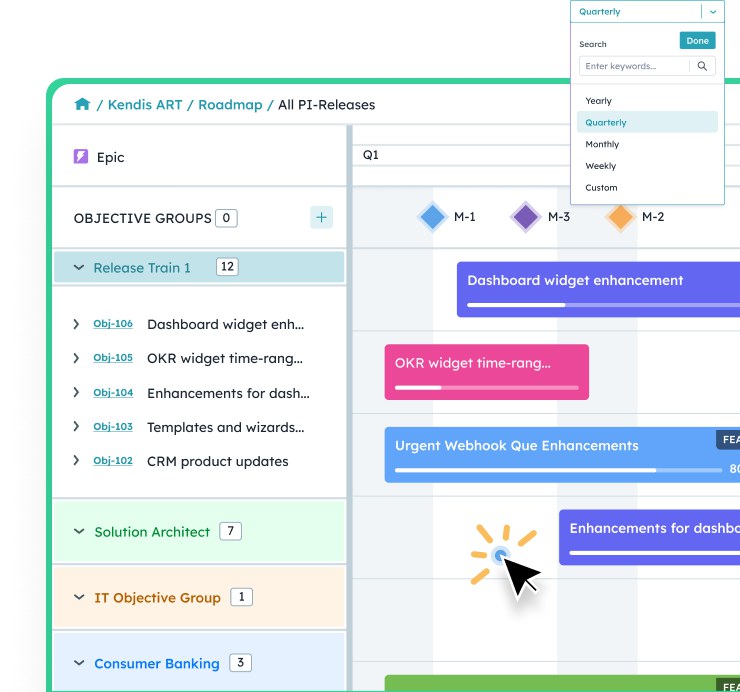
An OKR roadmap shows objectives and key results over time, grouped by train, team or theme, with the features that deliver them underneath. It tells stakeholders why work is planned and lets them follow progress by outcome rather than by feature count.
Put strategic objectives on the longest horizon and team key results by quarter or PI, and read an aspirational key result at 70% as success, not slippage. The agile roadmap guide covers roadmap types and formats in more depth.
11. Cascading vs aligning OKRs
Cascading means each level takes a key result from the level above and turns it into its own objective. Aligning means teams write their own OKRs and link them to a parent objective. Strict cascading is slow and top-down; most organisations do best with a mix, where leaders set direction and teams propose how to contribute.
In a cascade, owners take a key result from above and "decide the best way to achieve those Key Results, which transformed into Objectives for the new owners".[12] What Matters also says healthy organisations "should aim to strike a balance between top-down and bottom-up goals".[12] Google's guide makes the same point: successful OKRs "can often come from a mix of top-down and bottom-up suggestions".[2]
12. Common OKR mistakes
The most common mistakes are not separating committed from aspirational goals, business as usual OKRs, too many OKRs, activities as key results, and setting OKRs once and never checking in.
- Not saying which OKRs are committed. Google lists this as trap number one: a committed OKR marked aspirational may not be taken seriously.[7]
- Business as usual OKRs. OKRs that describe what the team would do anyway.[7] Track those as KPIs.
- Timid or sandbagged goals. Google warns against both; committed OKRs should consume most, but not all, of a team's capacity.[7]
- Low-value objectives. Google calls this the "Who cares?" OKR.[7]
- Activities as key results. "Launch X" is a task. Measure what launching X should change.
- Too many OKRs. Ten objectives is a to-do list. Keep three to five.
13. OKR software and tools
Small teams can run OKRs in a spreadsheet. Once several teams or trains share objectives, OKR software helps by linking key results to work in Jira or Azure DevOps, rolling progress up and keeping check-ins in one place. Kendis does this alongside PI Planning.
The Kendis OKR tool covers three levels: organisational objectives linked to strategic themes, program or PI objectives connected to key results, and team key results that roll up. Key results link directly to features and user stories on the program board, each key result can carry a business value with business value achieved tracked on delivery, and check-ins record progress, confidence, blockers and notes. Data syncs from Jira or Azure Boards, and an OKR roadmap shows objectives over time by program or PI.
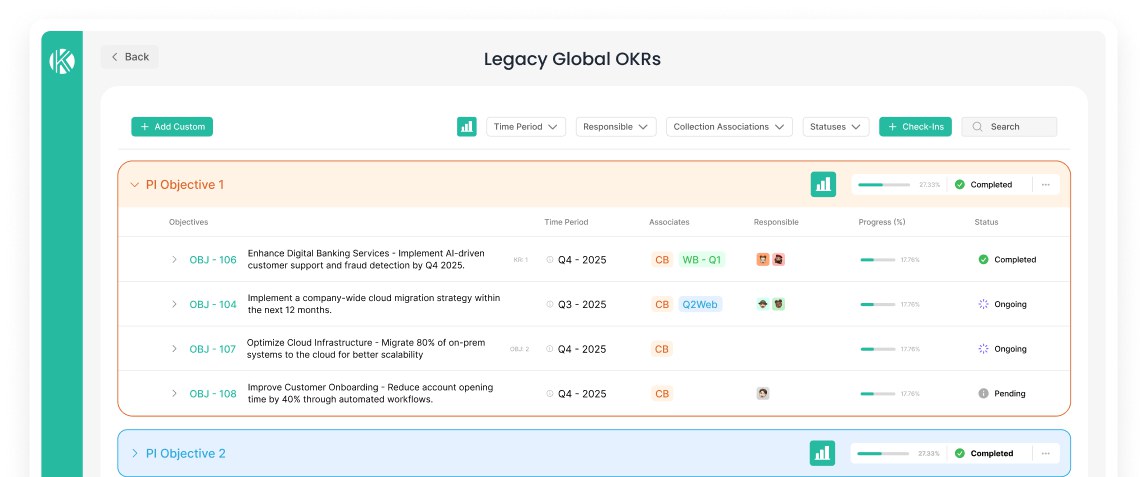
Team and custom objectives with business value are part of every Kendis plan, including the free trial. Strategic themes, global OKRs, organisation roadmaps and Kendis AI (Charlie), which can generate PI objectives from your planning context, are part of the ORG Views plan. See pricing for details.
Put this into practice, free for 6 months
Kendis is a PI Planning and tracking platform that sits on top of Jira and Azure DevOps. The free trial runs for six months, long enough to plan and track two full PIs with your real backlog before anyone has to approve a budget.
- 6 months free, no credit card
- Choose EU hosting (OVHcloud, Frankfurt) or US hosting (AWS)
- Planning board, dependencies, PI objectives, ROAM risks, solution boards
- Two-way sync with Jira Cloud, Jira Data Center and Azure DevOps
- ISO/IEC 27001 certified, GDPR compliant, DORA Schedule available
- No user caps and no setup costs during the trial
One trial per organisation that has not used Kendis in the last twelve months. After the trial, Premium Cloud is $14 per user per month billed annually, or $16 monthly, and you license only the people who plan. SSO, Kendis AI and premium support are part of paid plans. See pricing and the free trial terms.
OKRs: frequently asked questions
What are OKRs?
OKRs, or objectives and key results, are a goal-setting framework. An objective states what you want to achieve; three to five measurable key results show whether you achieved it. Teams usually set them quarterly.
What is the difference between an OKR and a KPI?
A KPI is an ongoing measure of performance, such as uptime or revenue. An OKR is a time-boxed goal to change something, measured by key results. KPIs measure health; OKRs measure change.
What is a good OKR score?
For aspirational OKRs, 0.6 to 0.7 on a 0.0 to 1.0 scale is the sweet spot Google describes. Committed OKRs are expected to score 1.0.
How many OKRs should a team have?
Google suggests three to five objectives with about three key results each. Fewer is usually better.
What is the difference between committed and aspirational OKRs?
Committed OKRs must be fully achieved, and the team adjusts schedules and resources to do so. Aspirational OKRs are stretch goals with no clear path yet, where an average score around 0.7 is expected.
How do OKRs work in agile?
OKRs give agile teams an outcome to aim the backlog at. Teams link features and stories to key results and use short check-ins to see whether shipped work moves the numbers.
Are PI objectives the same as OKRs?
No. PI objectives describe what a team or train will deliver in one PI and are measured by business value. OKRs describe the outcome and how it is measured. In practice, PI objectives work best when each one supports a key result.
Should OKRs be linked to compensation?
Generally no. Google says OKRs are not synonymous with employee evaluations, and What Matters notes OKRs were designed to be divorced from compensation.
Sources
Every external claim in this guide links to the primary source below. All links were checked on 14 October 2026.
- What Matters (Ryan Panchadsaram). What is an OKR? OKR Meaning, Definition and Examples.
- Google re:Work. Set goals with OKRs.
- Scaled Agile, Inc. OKRs (Extended Guidance).
- Scaled Agile, Inc. SAFe Glossary.
- What Matters. OKR Examples and How to Write Them.
- What Matters. Measure What Matters, the book by John Doerr (2018).
- Google, published by What Matters. Google's OKR Playbook.
- What Matters. How to Grade OKRs.
- Scaled Agile, Inc. Strategic Themes.
- Scaled Agile, Inc. PI Objectives.
- Scaled Agile, Inc. Planning Interval (PI).
- What Matters. Cascading (Top-Down) OKR Examples.
How this guide is maintained: definitions are checked against the framework pages and other primary sources listed above, and the guide is updated when terminology or guidance changes. Examples, checklists and practical advice are Kendis guidance and are not official SAFe material. SAFe and Scaled Agile Framework are registered trademarks of Scaled Agile, Inc.