What is the PI Planning confidence vote?
The confidence vote is the last check of PI Planning: once the plans are final and the risks have been discussed, every team member, and then the whole Agile Release Train, votes on how confident they are that the PI Objectives can be delivered. It is usually done as a fist of five, from one finger (no confidence) to five (very high confidence). Low votes trigger a conversation and, if needed, a rework of the plan.
The SAFe glossary puts it in one sentence: "The Confidence Vote measures the teams' and ARTs' belief in their ability to deliver the established PI Objectives."[1] It is not a vote on whether people like the plan. It asks: given what we know now, can we do what we just said we would do?
PI Planning ends in a commitment, and a plan only managers believe in is a forecast. The vote makes doubt visible while the train is still in the room, and people engage more with a plan they had a real say in. For the full event, read the PI Planning guide.
When does the confidence vote happen in PI Planning?
On day two, after the final plan review and after the ART risks have been ROAMed. The vote is followed by plan rework, if it is needed, and then the planning retrospective.
The order is deliberate. The archived SAFe 5 PI Planning article describes it this way: "Once ART PI Risks have been addressed, teams vote on their confidence in meeting their team PI objectives."[2] Voting before the risks are on the table would measure optimism. A typical day two afternoon:
- Final plan review: teams present their plans and objectives.
- ART risks: risks are ROAMed in front of the train. See the ROAM risk guide.
- Confidence vote: first per team, then for the whole train. About 15 minutes is usually enough.
- Plan rework, if needed: teams adjust their objectives until confidence is acceptable.
- Retrospective of the event, led by the RTE.
Leave real time between the vote and the retrospective. If a low vote would make everyone late, that pressure shows up in the votes.
The fist of five scale: what each vote means
Each person shows one to five fingers at the same moment. Five means very high confidence, three means "good enough to commit", and one or two mean the person has a concern the train needs to hear before it commits.
| Vote | Meaning | What happens next |
|---|---|---|
| 5 fingers | Very high confidence. The plan is realistic. | Nothing. |
| 4 fingers | High confidence. Open questions, none that threaten the objectives. | Nothing. |
| 3 fingers | Good enough to commit, with known risks that need watching. | Check the risks have an owner on the ROAM board. |
| 2 fingers | Little confidence. Something important is unclear or needs more support. | The voter explains. It becomes a risk, a question or a plan change. |
| 1 finger | No confidence. A critical problem with the plan. | The voter explains. Business Owners and the RTE step in before the plan is accepted. |
| Fist (optional) | "I do not understand the plan well enough to vote." | A communication gap: explain the plan, then vote again. |
Two details make the scale work: everyone votes at the same time, so nobody waits to see what the manager does, and the meaning of each number is on screen before the vote. Copy a blank version from the confidence vote template in our free PI Planning template.
How do you read the result? The "average of three" rule
A common working rule: if a team's average is three or more, the plan is accepted; if it is below three, the team reworks its plan; and anyone who votes one or two explains their concern, whatever the average is. Treat this as common practice, not a fixed SAFe rule.
The rule comes from earlier SAFe guidance. The archived SAFe 5 article says: "If the average is three fingers or above, then management should accept the commitment. If it's less than three, the team reworks its plan. Anyone voting two fingers or fewer should be allowed to voice their concerns."[2] The public SAFe 6 pages do not state a threshold, so agree one with your Business Owners. Two cautions:
- An average hides a split. A team voting 5, 5, 5, 1, 1 averages 3.4 and passes, but two people see a problem the others do not. Always hear the low voters.
- Low votes are information, not dissent. SAFe notes that the concerns raised "might add to the risk list, require replanning, or provide information."[2] Any of the three is a useful result.
Team vote vs ART vote
Each team first votes on its own team PI Objectives. Then everyone votes once more on the plan for the whole Agile Release Train. A train can have confident teams and still be unsure of the combined plan.
In the words of the archived SAFe 5 guidance: "Once each team has voted, it's repeated for the entire ART, with everyone expressing their confidence in the collective plan."[2]
- The team vote tests capacity, estimates and the team's own objectives.
- The ART vote tests what no single team owns: cross-team dependencies, shared environments, release dates and the risks ROAMed a few minutes earlier. Low votes usually lead to a conversation between the RTE, Product Management and the Business Owners.
If every team votes 4 but the train votes 2, look at the dependencies between teams first.
What to do when confidence is low
Hear the concerns, find the cause, change the plan, and vote again. Teams adjust their objectives until they have confidence in them, even if that takes longer than the timebox.
Use this loop:
- Listen. Ask each one or two voter: "What would have to change for you to vote three?"
- Sort. Each concern is a new risk, a question someone in the room can answer now, or a sign the plan does not fit.
- Act. ROAM risks, answer questions, rework the plan in a short breakout.
- Re-vote on the reworked plan.
| What voters say | Likely cause | Rework option |
|---|---|---|
| "We cannot fit all of this." | Load above capacity | Move a feature out or make an objective uncommitted |
| "Team X has not confirmed." | Unconfirmed dependency | Get a date from the providing team, or re-sequence |
| "What does done mean here?" | Unclear objective or business value | Product Management and Business Owners clarify |
| "The supplier may not be ready." | Risk not ROAMed | ROAM it with an owner, or plan around it |
| "Key people are on leave." | Capacity not based on real availability | Correct capacity and replan |
Making an objective uncommitted is often the cleanest fix. Uncommitted objectives are built into the plan but not committed to "because of too many unknowns or risks", and they "are not extra things to do in case there is time."[2] SAFe treats this extra planning as worth the time: it is "one occasion where alignment and commitment are valued more highly than adhering to a timebox."[2]
A vote that is always five also deserves a look: it can mean slack in the plan, or a room where people do not feel safe voting low.
Running the confidence vote remotely or hybrid
Use a digital vote with a timer instead of fingers on camera. Everyone, in the room or remote, votes in the same tool, the results appear together, and the low voters are invited to speak on the call.
SAFe has long allowed this: teams vote "using their fingers (fist of five) or a digital tool for remote events."[2] Fingers on video fail: cameras are off, people see each other's hands and adjust, and nobody can count 80 tiles.
- One tool for everyone. In a hybrid event, do not let the room vote by hand while remote people type in chat; the room will dominate.
- Use a timed window so people vote at once instead of waiting for the trend.
- Decide on anonymity in advance. Anonymous votes are more honest; named votes make follow-up easier. A common compromise is anonymous votes, with low voters invited, not forced, to explain.
- Include people without an account, such as Business Owners, suppliers and contractors.
- Plan for time zones. Schedule the vote when every location is awake.
More on running the whole event online is in remote PI Planning.
A short facilitator script
The RTE, or a Scrum Master for a team vote, can run the vote in five steps.
- Set the question. "How confident are you that we can deliver these PI Objectives, with the risks we just ROAMed?"
- Show the scale. "Five is very high confidence, three is good enough to commit, one or two means you have a concern we need to hear. If you do not understand the plan, say so."
- Vote together. "On three, show your fingers," or "The vote is open for two minutes."
- Invite the low votes. "Thank you. I see some ones and twos. What would have to change for you to vote three?" Thank them, every time.
- Close or loop. "Average 3.8, and both concerns are now owned risks. We commit." Or: "We are below three. Twenty minutes of rework, then we vote again."
Common confidence vote mistakes
Most problems come from pressure, from voting too early, or from ignoring what the low voters said.
- Voting before the risks are discussed. The vote then measures hope, not confidence.
- Managers voting first or reacting to votes. A sigh from a Business Owner after a "2" teaches the room to vote 3 next time. Reveal votes at the same time and keep reactions neutral.
- Treating 3 as a pass and moving on. Hear every one or two, even when the average is fine.
- No time left for rework. If a low vote cannot change anything, people stop voting honestly.
- Weak inputs. A vote cannot fix poor estimates, unranked features or hidden dependencies. Confidence needs a plan where work, dependencies and risks are visible.
- Not following up. Store the result with the plan and revisit it at Inspect and Adapt: did low confidence predict the missed objectives?
How Kendis runs the confidence vote
In Kendis the confidence vote runs on the PI board itself: you choose a vote per team, for the whole PI or both, set a time window, and the result is stored with the plan. People without a Kendis account can vote through a unique, secure link.
- Three scopes. PI + Team (participants vote on the overall PI plan and on their own team's plan), PI only, or Team only.[3]
- Timed sessions. An Admin or PI Admin starts the vote from the Program Increment board with a duration of 5 to 99 minutes. Votes can be changed while the session is open.[3][4]
- Voting without an account. Kendis generates secure, shareable links for the overall PI and for each team. External voters enter their name and email, and their votes appear in the results with everyone else's.[3]
- A clear scale. Voters choose from No confidence, Little confidence, Good confidence, High confidence and Very high confidence, plus an "I don't understand" option.[3]
- Anonymous by default. Admins choose whether participants can see the results and whether voter names are shown.[3][4]
- Results you can act on. See the PI result, drill down per team, export or email the results, and resume the vote after rework.[3]
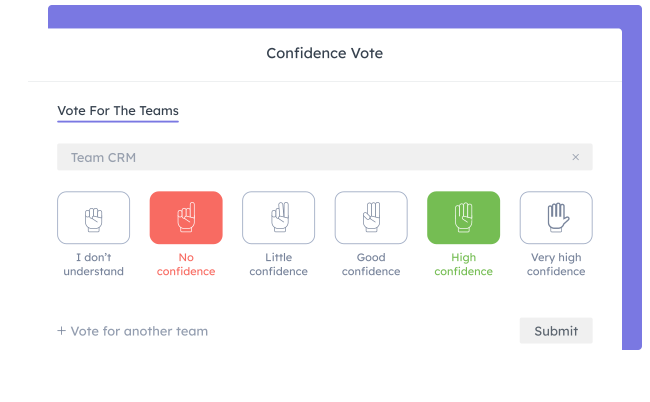
The vote sits next to the program board, PI objectives and ROAM risks, synced with Jira or Azure DevOps. See PI Planning in Kendis.
Run your next confidence vote in Kendis, free for 6 months
Kendis is a PI Planning and tracking platform that sits on top of Jira and Azure DevOps. The free trial runs for six months, long enough to plan and track two full PIs with your real backlog before anyone has to approve a budget.
- 6 months free, no credit card
- Choose EU hosting (OVHcloud, Frankfurt) or US hosting (AWS)
- Planning board, dependencies, PI objectives, ROAM risks, solution boards
- Two-way sync with Jira Cloud, Jira Data Center and Azure DevOps
- ISO/IEC 27001 certified, GDPR compliant, DORA Schedule available
- No user caps and no setup costs during the trial
One trial per organisation that has not used Kendis in the last twelve months. After the trial, Premium Cloud is $14 per user per month billed annually, or $16 monthly, and you license only the people who plan. SSO, Kendis AI and premium support are part of paid plans. See pricing and the free trial terms.
More PI Planning resources
PI Planning confidence vote: frequently asked questions
What is a confidence vote in SAFe?
The step near the end of PI Planning where each team, then the whole Agile Release Train, votes on its confidence in delivering the PI Objectives, usually as a fist of five.
What is a good confidence vote score?
A common working rule: an average of three or more means the plan can be accepted. Anyone voting one or two still explains their concern.
What happens if the confidence vote is low?
Low voters explain their concerns, which become risks, answers or plan changes. The team reworks its plan, for example by moving scope out or making an objective uncommitted, and votes again.
Who votes in the PI Planning confidence vote?
Everyone on the teams that planned votes on their team plan, and everyone on the Agile Release Train votes on the plan for the whole train. The RTE facilitates the train vote.
How do you run a confidence vote remotely?
Use a timed digital vote so everyone, in the room and online, votes at once, then invite the low voters to speak. In Kendis, people without an account can vote through a secure link.
Is the confidence vote anonymous?
A fist of five in the room is visible to everyone. In Kendis, votes are anonymous by default and admins can choose to show who voted for each option.
Sources
Every external claim in this guide links to the primary source below. All links were checked on 20 October 2026.
- Scaled Agile, Inc. SAFe Glossary.
- Scaled Agile, Inc. PI Planning (archived SAFe 5 version, last updated 19 March 2023).
- Kendis Help Center. Guide to the confidence vote ceremony in PI Planning.
- Kendis Help Center. Confidence vote for the PI Planning: setup and participation guide.
Definitions follow the SAFe glossary. The agenda position, the average of three rule and the team then ART sequence are quoted from the archived SAFe 5 PI Planning article, because the current SAFe 6 article is only partly public; treat the threshold as a common working agreement, not a SAFe 6 requirement. The scale wording, rework table and facilitator script are Kendis examples to adapt. If something is out of date, tell us and we will correct it.