Milestones in 60 seconds
- Definition: "A milestone is a specific goal, event, or point in time used to evaluate progress toward a larger objective."[1]
- No duration: in scheduling tools a milestone is a zero-time task, often drawn as a diamond.[2]
- Types: SAFe names PI milestones, fixed-date milestones and learning milestones.[3] Release, regulatory, contractual and solution milestones are common subtypes.
- In agile: milestones should be based on objective evidence from working systems, not on documents passing a phase gate.[4]
- Tracking: a milestone is only as safe as the work it depends on, so link that work and watch it.
1. What is a milestone?
A milestone is a point in time that marks a significant event in a project or programme, used to check progress toward a larger objective. It has no duration of its own. It is reached when something specific is true, such as a release shipped, an audit passed or a contract stage met.
Wikipedia describes milestones as "tools used in project management to mark specific points along a project timeline", such as a start or end date, "a need for external review or input and budget checks."[2] SAFe's definition adds the purpose: a milestone is "used to evaluate progress toward a larger objective."[1] A good milestone answers two questions: what will be true, and what does it say about the goal?
A milestone does no work by itself: "In many instances, milestones do not impact project duration."[2] The work happens in the tasks, stories and features that lead up to it.
Milestone vs task, deliverable, deadline and goal
| Term | What it is | Has duration? | Example |
|---|---|---|---|
| Milestone | A checkpoint that is reached or not | No, it is a point in time | Payments platform cut over |
| Task | A piece of work someone does | Yes | Migrate the card tokens |
| Deliverable | A tangible output of the work | No, but it takes work to produce | The new payments service |
| Deadline | The latest date something must happen | No | Must be live by 2 October |
| Goal or objective | The outcome the work is for | Usually a period | Cut checkout failures by half this year |
The terms overlap: a milestone often has a deadline and is often met when a deliverable is accepted. But only the milestone tells you whether you are on the way.
2. Types of milestones
The main types of milestone are fixed-date milestones, learning milestones and PI (Planning Interval) milestones, which are the three SAFe defines. In practice teams also name release, regulatory, contractual, solution and market-event milestones, which are usually special cases of fixed-date milestones.
- PI milestones. SAFe describes PIs as "time-based milestones that appear on most roadmaps as they provide cadence-based, objective measures of progress".[3]
- Fixed-date milestones "include events, release dates, contractual obligations, and scheduling of deliverables that must occur on or before a specific date."[3] Examples include trade shows, customer demos and contracts with "intermediate and payment milestones".[3]
- Learning milestones "help validate technical and business opportunities and hypotheses."[3]
- Release milestones mark when value reaches customers. In SAFe, "market rhythms and milestones on the roadmap inform release timing".[5]
- Regulatory milestones come from outside. SAFe lists "patent filing, internal or regulatory audits and certification, user acceptance testing" among the concerns that "must be identified and made visible on roadmaps."[3]
- Contractual milestones often carry money. Some contracts include "a 'milestone fee' that may be paid out when certain points are achieved."[2]
3. Milestones in project management vs agile
In traditional project management, milestones mark the end of phases and are checked at phase gates. Milestones in agile are mostly cadence-based: each iteration or PI ends with working software that can be evaluated. Fixed-date milestones still exist, but they are kept few and visible on the roadmap.
| Traditional (phase-gate) | Agile and SAFe | |
|---|---|---|
| Typical milestone | Requirements signed off, design approved, build complete | Iteration or PI end, release, learning milestone |
| Evidence | Documents and approvals | A working, integrated system that can be demonstrated |
| Placement | At the end of each phase | On a fixed cadence, plus a few fixed dates |
| Use in scheduling | Anchors for the critical path | Checkpoints on the roadmap and PI plan |
| Risk signal | Late: often at final testing | Early: every PI shows real progress |
Combined with PERT or the critical path method, milestones "allow project managers to much more accurately determine whether or not the project is on schedule."[2] The same article notes a weakness: milestones "usually show progress only on the critical path, and ignore noncritical activities."[2]
SAFe goes further. Its glossary defines phase gates as "governance milestones based upon sequential, legacy approaches to measuring progress".[1] Its fifth Lean-Agile principle is "Base milestones on objective evaluation of working systems", because "integration points provide objective milestones at which to evaluate the solution throughout the development life cycle."[4] The older SAFe roadmap article is blunter: "experience has shown that stage gate milestones generally do not reduce risk."[3]
Dates do not disappear. SAFe's current guidance says "milestones allow teams to track their progress and adjust as needed".[6] What changes is what counts as evidence.
4. Project milestone examples
Good milestone examples name an event that is clearly reached or not: a release shipped, an integration working end to end, an audit passed, a pilot customer live, or a PI system demo accepted. The examples below are illustrative and not taken from a real project.
| Milestone | Type | Evidence it is met | Work it depends on |
|---|---|---|---|
| PI 3 system demo accepted | PI boundary | Integrated increment demonstrated to Business Owners | All committed PI 3 features |
| Payments platform cut over | Fixed-date | All card traffic on the new platform | Token migration, fraud rules, rollback plan |
| Peak-season code freeze | Market event | Only emergency fixes merged after this date | Checkout and loyalty features finished |
| PCI audit sign-off | Regulatory | Auditor report received with no open findings | Logging, access control, evidence pack |
| Wallet pilot decision | Learning | Pilot results reviewed; persevere or pivot agreed | Pilot build, analytics events |
| Version 4.2 released | Release | Version shipped to all customers | Stories assigned to the version |
| Supplier API integrated | Contractual | End-to-end test passes; payment stage invoiced | Partner sandbox, contract tests |
Each example is a state, not an activity. "Testing phase" is not a milestone. "PCI audit sign-off received" is.
5. How to set milestones, step by step
Start from the objective, name the event rather than the activity, choose the type and date, agree the evidence, link the work it depends on, show it on a shared timeline, then track it every iteration and review it at each PI boundary.
- Start from the objective. Write down the larger objective the milestone will evaluate: a release goal, a PI objective or a contract outcome.
- Name the event, not the activity. Phrase it as a state that is reached or not: "Payments platform cut over", not "Work on payments".
- Choose the type and the date. Decide whether the date is fixed from outside, set by the cadence, or a forecast. Only fixed dates are immovable.
- Define the evidence. Agree what proves it is met: a working system demonstrated, an audit passed, a release shipped.
- Link the work it depends on. Connect the features, capabilities or stories that must be done first, and the teams that own them.
- Put it on the shared timeline. Show it on the same roadmap or timeline as the work that leads to it.
- Track status every iteration. Check the linked work, mark the milestone on track, at risk or slipped, and act early.
- Review at each PI boundary. At PI Planning and Inspect and Adapt, confirm, move or retire milestones.
Tip from the fieldKeep the list short. If every sprint has a milestone, none stand out. A handful of fixed-date and learning milestones per PI is usually enough.
6. What is a milestone chart, and how do you read it?
A milestone chart is a timeline that shows milestones as diamonds on their dates, often above the bars of the work that leads to them. Read it from left to right: find today's line, look at the next diamonds, and check whether the bars they depend on will finish in time.
In project management software, a milestone "is done as a zero-time task and appears with a special notation", such as a black diamond.[2] SAFe's roadmap example uses the same convention: it "depicts milestones as diamonds, while a solution release is shown with a small box."[3]
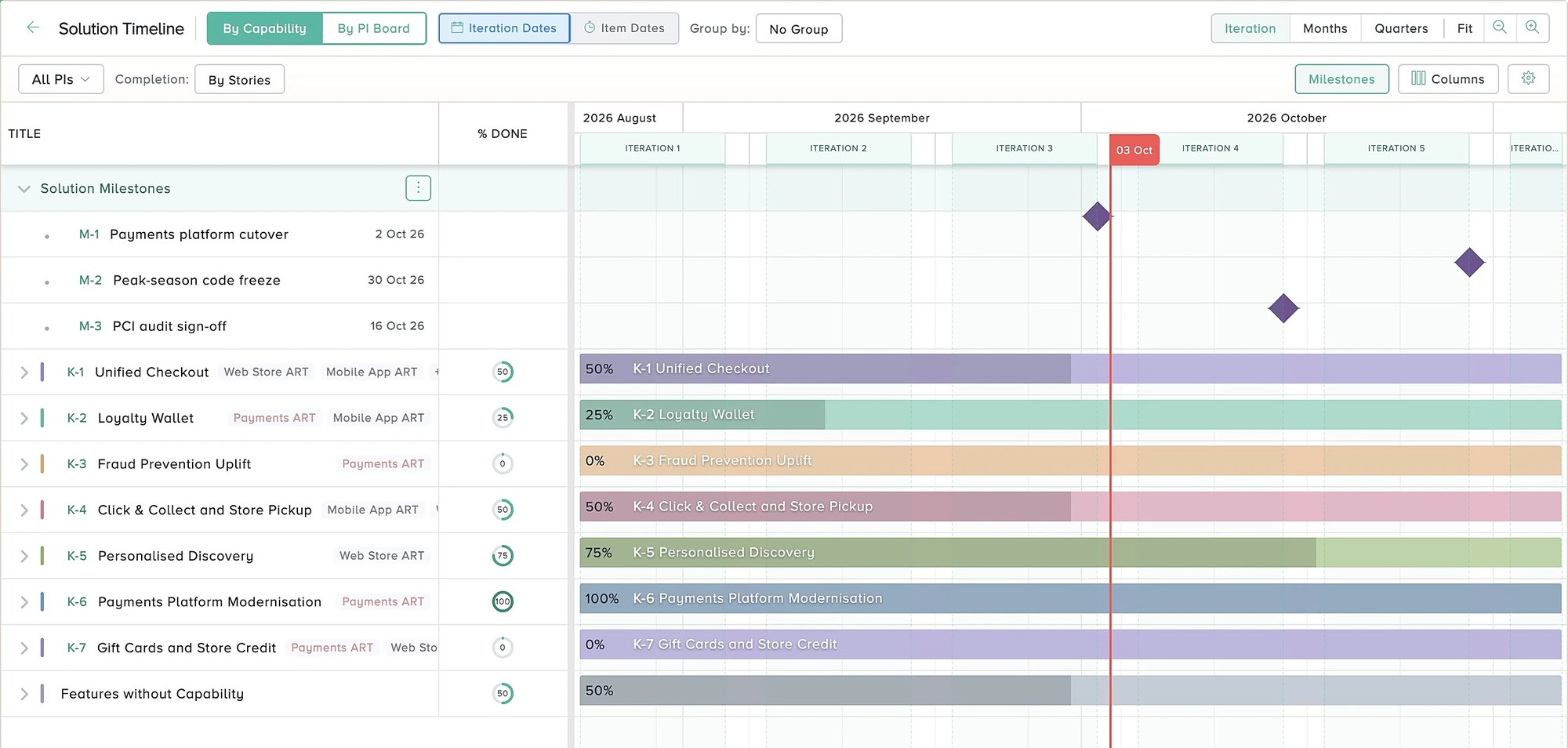
How to read the chart above:
- The diamonds are the milestones: a payments cutover on 2 October, a PCI audit sign-off on 16 October and a peak-season code freeze on 30 October.
- The red line is today. The cutover diamond sits just before it, so it should already be met.
- The bars are capabilities, with percent complete on each. A capability at 0% that a near milestone depends on is the first thing to ask about.
For when a timeline helps an agile team and when it hurts, see the agile Gantt chart guide.
7. Milestone tracking and reporting
Milestone tracking means checking, on a regular cadence, whether each milestone will be met, based on the progress of the work it depends on. A useful report shows status, the original and current date, the linked features and their progress, and the response to any slippage.
| Status | Meaning | What to do |
|---|---|---|
| On track | All linked work is forecast to finish before the date | Keep watching at each sync |
| At risk | At least one linked item is late or blocked | Raise it at the ART Sync; log a risk and ROAM it |
| Slipped | The date has passed or has been moved | Record the new date and the reason; tell stakeholders |
| Met | The agreed evidence exists | Close it and keep it on the chart as history |
| Retired | The milestone no longer serves the objective | Remove it openly rather than letting it go stale |
Track the dependencies, not just the date
A milestone rarely slips on its own. It slips because a feature it needs is late, often in another team. When a linked item moves past the milestone date, that is your early warning. Cross-team links are covered in the dependency management guide.
Report slippage honestly
Keep the original date next to the current one, give the reason in one line, and say what happens next: a scope cut, a new date, or a decision needed from Business Owners.
8. Milestones on roadmaps and PI boards
Milestones appear at every level of planning. Portfolio and solution roadmaps show the big fixed dates and market events for the next year or more. The PI roadmap shows fixed-date and learning milestones for the next three PIs. The PI board shows the milestones that matter this PI, next to the features and dependencies that lead to them.
SAFe defines a roadmap as "a schedule of events and milestones that forecasts and communicates planned solution deliverables over a time horizon."[1] Product and solution roadmaps "provide a longer-term view of key milestones and deliverables needed to achieve the product or solution vision over time."[6] The PI roadmap "may also reflect fixed-date and learning milestones during that period."[3] For roadmap types and formats, see the agile roadmap guide.
Market rhythms belong here too. SAFe defines a market rhythm as "a set of significant events that occur periodically on a predictable cadence", such as a retailer preparing for the holiday season, and notes that market events "are typically represented on the roadmap as milestones."[3] They may cause adjustments to the timing of features, often identified during PI Planning.[3]
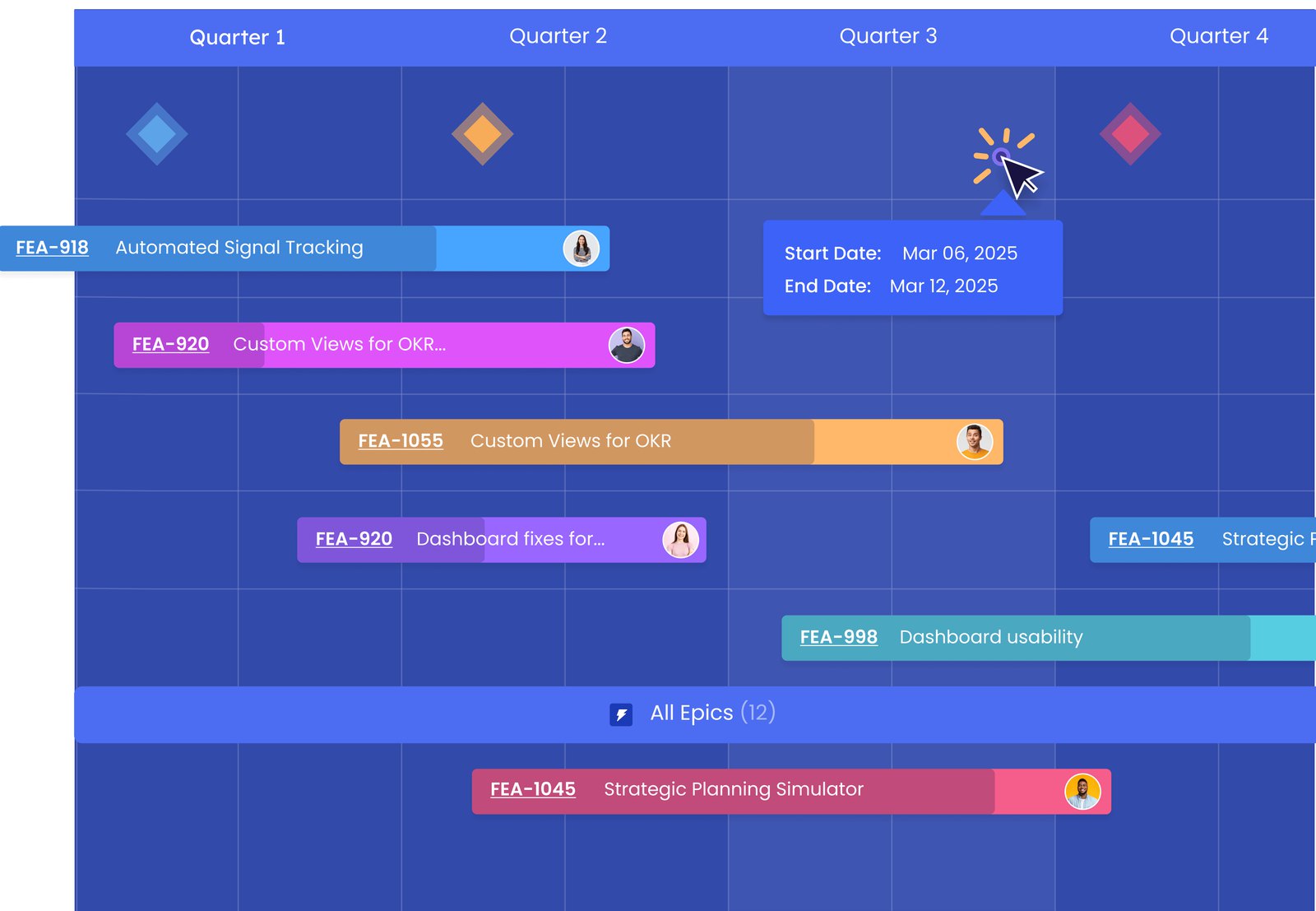
Within a PI, the ART Planning Board (program board) is "a visualization of the PI's feature delivery dates, feature dependencies among teams, and relevant milestones."[1] Teams build it during PI Planning, so a milestone placed on the board shapes which features land in which iteration. For a Solution Train, the same view one level up is the solution board, where solution milestones sit above capabilities from several trains.
9. Common milestone mistakes
- Milestones that are activities. "Development" or "testing" cannot be reached. Name the state you expect.
- Treating forecasts as fixed dates. Mark which milestones are truly fixed and which are expected.
- No linked work. A milestone with no features attached cannot be tracked, only hoped for.
- Document-based evidence. A signed-off design says little about progress. Prefer a working system.[4]
- Hiding slippage. Moving a date quietly destroys trust in the chart. Keep the history.
- A spreadsheet of dates. It does not move when the work does.
10. Milestone tracking tools: Jira, Azure DevOps and Kendis
Jira teams usually model release milestones as versions and see work on a timeline. Azure DevOps teams add milestone markers to Delivery Plans. Scaled programmes that need milestones linked to features across many teams and trains add a planning layer such as Kendis on top of Jira or Azure DevOps.
| Tool | How milestones are shown | Notes |
|---|---|---|
| Jira Cloud | Versions (releases) and the timeline | A version is "a set of features and fixes released together as a single update".[7] The release hub shows "the status of a version at a point in time".[8] The timeline is a Gantt-style view of one space; cross-space plans need Premium or Enterprise.[9] |
| Azure Boards | Markers on Delivery Plans | Up to 30 milestone markers per plan, each with a date, a label and a colour.[10] |
| Kendis | Milestones on timelines, roadmaps and solution boards | Milestones for single dates and phases for date ranges; link the capabilities, features and stories a milestone depends on and see its progress, live from Jira or Azure DevOps. |
In Kendis, the solution board timeline draws milestones as diamonds above the capabilities, and you can link the capabilities, features and stories a milestone depends on and see its progress. A milestone can be shared with other collections, PI boards and solution boards, so one date serves every train that needs it. The timeline shows features, stories, dependencies and milestones across PI iterations. Features can be linked to milestones as well as PI objectives and strategic themes, program analytics can be filtered by milestone, and product roadmaps align the portfolio with business goals and milestones.
Put this into practice, free for 6 months
Kendis is a PI Planning and tracking platform that sits on top of Jira and Azure DevOps. The free trial runs for six months, long enough to plan and track two full PIs with your real backlog before anyone has to approve a budget.
- 6 months free, no credit card
- Choose EU hosting (OVHcloud, Frankfurt) or US hosting (AWS)
- Planning board, dependencies, PI objectives, ROAM risks, solution boards
- Two-way sync with Jira Cloud, Jira Data Center and Azure DevOps
- ISO/IEC 27001 certified, GDPR compliant, DORA Schedule available
- No user caps and no setup costs during the trial
One trial per organisation that has not used Kendis in the last twelve months. After the trial, Premium Cloud is $14 per user per month billed annually, or $16 monthly, and you license only the people who plan. SSO, Kendis AI and premium support are part of paid plans. See pricing and the free trial terms.
Milestones: frequently asked questions
What is a milestone?
A milestone is a specific goal, event or point in time used to evaluate progress toward a larger objective. It has no duration of its own and is either reached or not.
What is a milestone in project management?
A milestone marks a significant point on the project timeline, such as the end of a phase, an external review or a payment stage. In scheduling tools it is a zero-duration task drawn as a diamond.
What is the difference between a milestone and a task?
A task is work that takes time and effort. A milestone is a point in time with no duration that shows a set of tasks or deliverables has been completed.
What are examples of project milestones?
A release shipped, an integration working end to end, an audit passed, a pilot customer live, or a PI system demo accepted.
What are the types of milestones in SAFe?
SAFe describes PI milestones, which come from the cadence of Planning Intervals, fixed-date milestones such as events, releases and contractual dates, and learning milestones, which test business or technical hypotheses.
Do agile teams use milestones?
Yes. Agile teams use the end of each iteration or PI as a checkpoint based on working software, and keep a small number of fixed-date and learning milestones on the roadmap and PI board.
What is a milestone chart?
A milestone chart is a timeline that shows milestones as diamonds on their dates, often above the bars of the work that leads to them, so you can see whether that work will finish in time.
How do you track milestones?
Link each milestone to the work it depends on, check that work every iteration, mark the milestone on track, at risk, slipped or met, and keep the original date next to any new one.
Sources
Every external claim in this guide links to the primary source below. All links were checked on 14 October 2026.
- Scaled Agile, Inc. SAFe Glossary.
- Wikipedia. Milestone (project management).
- Scaled Agile, Inc. Roadmap (SAFe 6.0 article, archived 22 January 2024).
- Scaled Agile, Inc. SAFe Lean-Agile Principles.
- Scaled Agile, Inc. Release on Demand.
- Scaled Agile, Inc. Roadmap (last updated 25 February 2025).
- Atlassian Support. What is a version?.
- Atlassian Support. Check the release status of a version.
- Atlassian Support. What does the space timeline show?.
- Microsoft Learn. Add or edit a delivery plan (Azure Boards).
How this guide is maintained: definitions are checked against the framework pages and other primary sources listed above, and the guide is updated when terminology or guidance changes. Examples, checklists and practical advice are Kendis guidance and are not official SAFe material. SAFe and Scaled Agile Framework are registered trademarks of Scaled Agile, Inc.